If you want to scale your content, you have to stop creating one piece at a time. The real secret is to stop making content and start building a system. It's a mindset shift from a manual, brute-force effort to an efficient engine that runs on smart planning, templates, and automation. This guide is the blueprint for building that engine.
The Modern Content Treadmill is Real

Let's be honest: keeping up with the relentless demand for daily videos on TikTok, Reels, and Shorts can feel like a losing battle. The old way—painstakingly crafting one video from scratch every single day—is a one-way ticket to burnout. It’s just not built for a world that rewards high-volume, consistent output.
The pressure is on, and the numbers back it up. We're seeing explosive growth in short-form video, with brands on YouTube Shorts now posting an average of 16.21 videos per month. But here's the kicker: many are seeing engagement drop at the same time, according to a recent short-form video data report from Marketing Tech News. It's the classic quality vs. quantity dilemma.
Why The Old Way Just Doesn't Work
The one-off creation model completely falls apart under the weight of modern content demands. Here’s why it’s a broken system:
- Creative Exhaustion: Coming up with fresh ideas, scripts, and visuals every single day is draining. It’s how you end up with stale, uninspired content.
- Inconsistent Output: When every video is a brand-new project, sticking to a consistent schedule is nearly impossible. That inconsistency kills your momentum with the algorithm.
- Wasted Effort: You're constantly reinventing the wheel. Without reusable assets or documented processes, every video takes far longer than it needs to.
This is the "content treadmill"—a cycle of frantic creation and inevitable burnout. Getting off doesn't mean working harder. It means working smarter.
The goal isn’t to become a content factory that churns out generic junk. It’s to build a content engine—a deliberate, systematized process that produces high-quality, on-brand content with predictable effort.
Building Your Content Engine
This guide lays out the full schematic for that engine. We're going to move from creative chaos to a streamlined workflow by focusing on four core pillars. Each one is designed to smash through the biggest bottlenecks in production, letting you multiply your output without killing yourself in the process.
To get started, let's look at the foundational strategies we’ll be building upon. I call them the Four Pillars of Content Scaling.
The Four Pillars of Content Scaling
This table gives you a quick overview of the core strategies we're about to dive into. Each pillar solves a specific, painful problem and leads to a tangible outcome.
| Pillar | Problem It Solves | Key Outcome |
|---|---|---|
| Planning & Batching | Daily content scramble and inconsistent ideas. | A predictable workflow with months of content planned in advance. |
| Templates & SOPs | Wasted time on repetitive tasks and brand inconsistency. | Faster production times and consistent, professional-looking content. |
| AI & Automation | Time-consuming technical work like editing and animation. | The ability to produce high-quality videos at unprecedented speed. |
| Team & Outsourcing | Hitting a personal capacity limit where you can't do more. | A scalable team that operates efficiently without your direct involvement. |
By really digging in and mastering these four areas, you’ll transform your entire process. Content creation will shift from being a daily chore to a powerful, sustainable system that drives real growth.
Building Your Content Engine with Planning and Batching
If you're stuck on the daily content treadmill, you know the feeling. Waking up, scrambling for an idea, shooting something quickly, and hitting post just to keep up. This reactive cycle is the single biggest killer of consistency and real growth.
To truly scale, you have to get out of that one-video-at-a-time mindset. The goal is to build a system—a content engine—that works for you, not the other way around. It all starts with a proactive strategy built on solid planning and smart batching. This is the foundation for everything else.
Establish Your Content Pillars
First things first, you need to define your core themes. We call these content pillars. Think of them as the 3-5 foundational topics your brand is built on. These are the subjects you want to be known for, the problems you solve for your audience.
Let's say you run a performance marketing agency. Your pillars might look something like this:
- Ad Creative That Converts: All about making killer video ads—hooks, visuals, and copy.
- Platform Deep Dives: Tactical guides for getting the most out of TikTok, Instagram, or YouTube Ads.
- Decoding Data & ROI: Making sense of the numbers to prove ad spend is working.
- Industry Buzz & Trends: Your take on the latest algorithm updates and market shifts.
These pillars become your creative guardrails. Every piece of content you create should tie back to one of them. This keeps your message tight, builds your authority, and ensures you're always delivering value to the right people.
From Pillars to an Avalanche of Ideas
Once your pillars are locked in, brainstorming is a breeze. Set aside an hour and just dump every possible video idea you can think of for each pillar. Don't judge them, don't overthink them—just get them out of your head and into a document.
The secret here is to separate the creative act of brainstorming from the logistical work of producing. When you try to do both at the same time, you get creative block.
Sticking with our agency example, that "Ad Creative That Converts" pillar could easily generate a ton of specific ideas:
- "The 3-Second Hook Formula I Use for Every Client"
- "Why Your UGC Ads Aren't Working (and How to Fix Them)"
- "My Go-To A/B Testing Framework for Ad Creatives"
- "How to Create High-Impact Visuals on a Shoestring Budget"
Repeat this for all your pillars, and you'll suddenly have a backlog of 50-100 video ideas. This idea bank is the fuel for your content engine, completely removing that daily "what do I post?" pressure.
The Content Assembly Line
With a stockpile of ideas ready, you can move to content batching. This is where the magic really happens. Instead of making one video from script to final post, you treat it like an assembly line, grouping all similar tasks together.
Why does this work so well? It's all about avoiding the "task switching cost." Every time your brain has to jump from writing to filming to editing, you lose momentum and focus. Batching lets you get into a deep state of flow by sticking with one type of task for a solid block of time.
A simple batching schedule might look like this for a week:
- Monday (Scripting Day): Lock yourself in a room and just write. Knock out the scripts for 15-20 videos. You're in writer mode, focused purely on the message.
- Tuesday (Filming/Asset Day): Get all the visuals you need. This could be filming all your talking head segments, gathering B-roll, or designing any graphics for the entire batch.
- Wednesday & Thursday (Editing Days): Now you're the editor. You're living in your editing software, focused on cuts, captions, sound, and making everything pop.
- Friday (Distribution Day): The final step. Upload everything, write your captions and descriptions, add hashtags, and schedule the entire batch out for the next few weeks.
This turns a chaotic, creative process into a predictable system. You produce a massive amount of content in a few focused days, which buys you weeks of freedom to focus on strategy, engage with your community, and actually analyze your results. This is how you finally get off the content treadmill.
Systematizing Creativity with Templates and SOPs
Once you've got a solid plan and a batching workflow humming along, the next real step in scaling up is to stop doing the same tedious tasks over and over. A common misconception is that systems kill creativity. The truth? Creativity thrives when it has a framework to lean on, one that handles all the boring stuff so you can focus on the actual message.
This is where templates and Standard Operating Procedures (SOPs) become your secret weapons. We're not talking about churning out cookie-cutter content. We're talking about building a powerful library of predefined structures and simple checklists that can slash your production time. Imagine getting your next video done 50% faster just because all the foundational decisions were already made for you.
This simple flowchart shows how we move from big-picture themes to concrete ideas and finally into creation—the stage where templates and SOPs really shine.
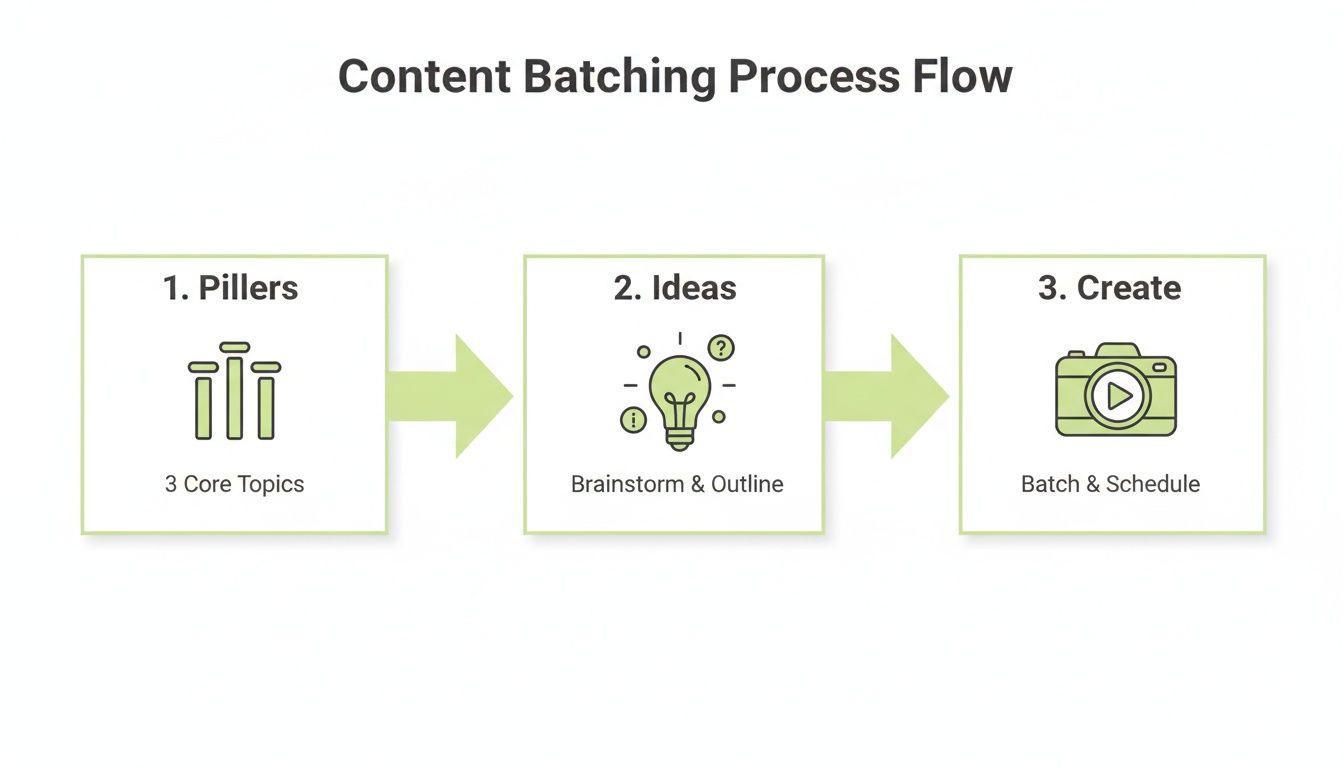
It’s all about having a repeatable system. That’s what turns abstract concepts into real assets, efficiently and predictably.
Develop Your Core Video Templates
A good template is so much more than a pre-made graphic. Think of it as a complete blueprint for a specific type of video. It should pre-define the structure, the pacing, text styles, and even exactly where your calls-to-action go. Creating just a handful of these core templates keeps your brand looking sharp and consistent while saving you a massive amount of editing time.
First, figure out which video formats you use most often. For most brands and creators, it usually comes down to a few key types:
- The Listicle Template: Perfect for those fast-paced "Top 5" or "3 Reasons Why" videos. The template might dictate a 2-second branded intro, 10-second clips for each point with bold text overlays, and a 3-second outro with a subscribe animation ready to go.
- The Tutorial Template: Designed for clear, step-by-step guides. This blueprint could include a standard intro, dedicated sections for screen recordings with consistent zoom effects, and pre-designed callout graphics to highlight important steps.
- The Reaction/Commentary Template: Ideal for sharing your take on industry news. This could feature a picture-in-picture layout, a specific font for quoting sources, and even pre-set audio EQs for your voiceover to ensure it always sounds crisp.
For example, a marketing agency could have a go-to product demo template. This ensures every client video they make follows the same proven formula: problem, solution, feature showcase, and a final CTA. It completely removes the guesswork.
Document Everything with Simple SOPs
If templates are your "what," then Standard Operating Procedures (SOPs) are your "how." An SOP is just a simple, documented process for a specific task in your workflow. Don't overthink it—they don’t need to be 50-page manuals. Often, a simple checklist in a Google Doc is all you need.
SOPs are the absolute key to delegation and quality control. They ensure that whether it's you, a new hire, or a freelancer doing the work, the result is always consistent and up to your standards.
By writing down your process, you make it repeatable and teachable. This is the only way to scale content creation beyond what you can do all by yourself.
Here are a few SOPs you can create right now to make a difference:
- The 5-Second Hook Formula: A checklist for writing and filming your video intros. It could include rules like "State the viewer's problem in the first sentence" or "Use a dynamic camera movement in the first shot."
- The B-Roll Sourcing Guide: A quick document outlining where the team can find approved stock footage, what style of clips to look for, and how to organize them for the editor.
- The Final Video Quality Checklist: A pre-publish review process. This is your last line of defense against mistakes, with checks for typos in captions, proper audio levels, correct branding, and a working link in the description.
These systems aren't here to crush your creative spark. They exist to handle the predictable, mind-numbing parts of the job. This frees up your mental energy for what actually matters: creating content that truly connects with your audience.
Using AI Automation for Hyper-Speed Production
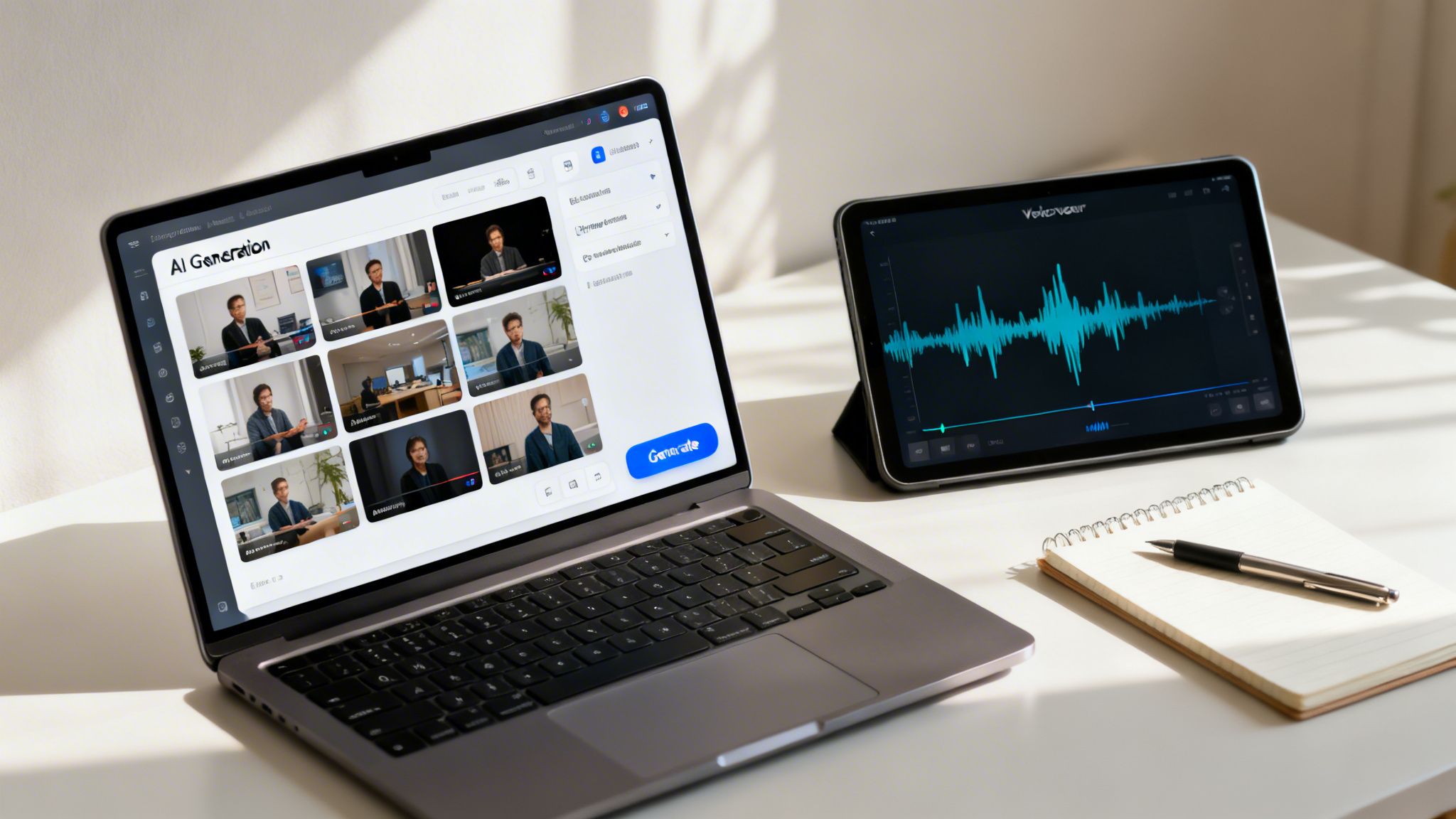
If solid planning and templates are the foundation of your content engine, then AI is the turbocharger. We're not just talking about using AI to spit out a few script ideas anymore. It has become a genuine production partner, capable of handling the heaviest lifting in video creation.
This shift allows for a kind of speed and scale that would have sounded like science fiction just a few years ago. You get to move from being bogged down in execution to focusing purely on strategy and creative direction. That's the real secret when you're learning how to scale content creation.
Moving from AI Assistant to AI Creator
The first wave of AI was helpful, sure. It could brainstorm topics or polish up your copy. But the real game-changer is the new class of platforms that can generate entire video assets from a simple text prompt.
Let's imagine a practical scenario. A performance marketer needs to test ten different hooks for a new ad campaign to see what sticks. The old way? That’s a week of back-and-forth with a creative team, easily.
With a modern AI video generator, that entire process gets compressed into a single afternoon. You feed it the core message, ask for ten variations, and voilà—you have ten unique, high-quality animated videos ready for A/B testing in hours, not days. The speed of this iteration cycle is impossible to match with a traditional workflow.
AI automation isn't here to replace your creativity. It’s here to execute your creative vision at lightning speed. This lets you test more ideas, get data back faster, and figure out what your audience actually wants on a massive scale.
Building Your Full AI Production Stack
A truly automated workflow isn't about finding one magic tool. It's about building a stack of specialized AI tools that each solve a different production bottleneck, creating a seamless assembly line from idea to final video.
Here’s what a modern, AI-powered production stack looks like:
-
AI Video Generation: This is the heart of your operation. Platforms like Nereo are built to create entire animated shorts from a single prompt, handling everything from the story and characters to the art style. For many projects, this completely removes the need for animators and complex software.
-
AI Voiceover Generation: Finding the right voice talent and scheduling studio time is a huge time-sink. AI voice generators can produce incredibly natural-sounding audio in minutes. You get to pick from hundreds of voices and styles to perfectly match your brand’s tone.
-
AI Captioning and Transcription: Manually typing out and timing captions is tedious but absolutely necessary. AI services can generate accurate captions automatically in seconds, making your content accessible and optimized for silent viewing on social feeds.
-
AI Music and Sound Effects: I’ve lost count of how many hours I've wasted scrolling through stock music libraries. AI music tools can generate royalty-free tracks based on the mood, genre, or pace you describe. You get a custom soundtrack without the headache.
By pulling these tools together, you can build a workflow that is up to 90% faster for certain types of content. Generate the video, create a voiceover, add captions, and drop in a custom music track. The whole thing can be done in under an hour, turning content production into a highly efficient, high-volume operation.
Scaling Your Team and Maintaining Quality Control

As your output starts to ramp up, you’ll eventually hit a wall. There's a hard limit to what one person, even with the best systems and AI, can physically produce. True scale requires delegation. This is the moment you transition from being just a creator to the manager of a content operation.
Bringing on help—whether it’s your first VA or a team of specialized freelancers—can feel daunting. The big fear is that quality will immediately nosedive the second you hand over the reins. But with the right structure in place, you can absolutely expand your team without sacrificing the consistency your audience expects.
Defining Key Roles in Your Content Workflow
You don't need a huge payroll to start building out your team. The trick is to identify your biggest bottlenecks and hire for those specific pain points first. As you grow, a well-oiled content machine typically relies on a few core specialists.
Here are the essential roles I'd look at first:
- Content Strategist: This is your big-picture thinker. They live in the world of keyword research and performance data, figuring out what’s working and planning the content calendar. They answer the crucial question: "What should we create next to actually hit our goals?"
- Scriptwriter: This person takes the strategist's ideas and breathes life into them. A great scriptwriter knows how to craft a killer hook, tell a concise story, and write for the ear, not just the eye. They make sure every second of your video counts.
- Video Editor/Animator: This is your technician, the one who turns all the raw pieces into a polished final product. They handle the pacing, cuts, graphics, and sound, ensuring everything aligns with your brand’s visual identity. With tools like Nereo on the rise, this role might even evolve into an "AI Animator" who directs and refines the AI’s output.
Scaling your team isn't just about offloading tasks you hate. It's a strategic move to put experts in every part of your assembly line, letting you produce higher-quality content faster than you ever could alone.
Delegating with SOPs for Flawless Execution
Remember those Standard Operating Procedures (SOPs) we talked about earlier? This is where they become your single most valuable asset.
Tossing a project to a freelancer with a vague note like "edit this video" is a recipe for disaster and endless back-and-forth. But when you hand them a detailed SOP—like that "Final Video Quality Checklist"—you’re giving them a clear roadmap.
Your SOPs are the instruction manual for your brand. They ensure that anyone, anywhere in the world, can execute a task to your exact standards. The first thing a new editor should get isn't just the video files; it's the editing SOP, the brand style guide, and a link to your asset library. This simple step eliminates guesswork and saves you from the nightmare of endless revisions.
Implementing a Simple Quality Control Loop
Even with great people and perfect SOPs, you still need a final checkpoint. Quality control doesn’t have to be some stuffy, bureaucratic process. A simple, two-stage review system is often all it takes to keep your standards high.
Here’s a practical workflow you can use right away:
- Peer or Specialist Review: Before a video ever gets to you, have another team member give it a once-over. A scriptwriter can check another's script for flow, or an editor can get a strategist's take on the pacing. This simple step catches 80% of issues before they even land on your desk.
- Final Brand Review: Your job now is the final sign-off. You’re no longer hunting for typos or minor editing glitches. Instead, you’re asking the big-picture questions: "Does this feel on-brand? Is the message crystal clear? Does it serve our strategic purpose?"
This system keeps you in control of the final product without getting you stuck in the weeds. As your team grows, you can start looking into different pricing models to find what makes sense for your budget and workflow. By combining a skilled team with documented processes and a smart review loop, you'll be able to multiply your output while knowing every piece of content is consistently excellent.
Nailing Your Distribution and Optimization Workflow
You can create a mountain of incredible content, but it's all for nothing if nobody sees it. The final piece of the puzzle in scaling your production is building a rock-solid workflow for distribution and optimization. This is what closes the loop and turns your content machine into a growth engine.
<iframe width="100%" style="aspect-ratio: 16 / 9;" src="https://www.youtube.com/embed/MW-LKQ9q8cY" frameborder="0" allow="autoplay; encrypted-media" allowfullscreen></iframe>
Posting randomly whenever you have a free second is a surefire way to kill your momentum. The fix? Use scheduling tools to get your content uploaded and scheduled weeks ahead of time. This simple shift is a game-changer. It frees you from the daily grind of hitting "publish" and gives you back precious time to actually think about strategy.
Stop Posting the Same Video Everywhere
One of the most common mistakes I see people make when they start scaling is taking one video and blasting it across every platform without a second thought. That "one-size-fits-all" approach just doesn't fly. Viewer expectations and algorithms are completely different everywhere you go. A video that crushes it on TikTok might be dead on arrival on YouTube Shorts.
Optimizing for each channel is about making small, but powerful, adjustments. Maybe you tweak the on-screen text, change up the call-to-action, or swap in a different trending audio clip to fit the platform's vibe. These little changes make your content feel native and give it the best possible shot at performing well.
Understanding these nuances is key. For example, data on watch rates for smaller creators reveals that TikTok can offer quicker initial virality with an average 25% watch rate. On the other hand, YouTube Shorts, hovering around 10%, often plays the long game, tapping into YouTube's massive search and discovery engine for sustained growth. You can dig into more of this data on YouTube Shorts vs TikTok performance on awisee.com to see how these differences really shape your strategy.
Let Performance Data Drive Your Next Move
This is where your scaled content system becomes truly powerful: creating a feedback loop fueled by data. You're no longer just guessing what might work. You're using cold, hard metrics to decide what to create next. This is how you transform a creative hobby into a legitimate growth machine.
Block out time every single week to dive into your key performance indicators (KPIs) across all your channels. And don't just give the view count a passing glance—dig into the numbers that actually tell you a story.
- Audience Retention: Where are people dropping off? This is a goldmine for figuring out what parts of your videos are boring your audience.
- Engagement Rate: Which videos are getting the most comments, shares, and saves? This is your audience telling you exactly what they love.
- Click-Through Rate (CTR): Are people actually doing what you ask them to do? This tells you how effective your calls-to-action really are.
By analyzing this data, you stop making content you think your audience wants and start making content you know they want. This insight is what fuels sustainable, long-term growth and turns your scaling efforts into a predictable success.
This constant cycle—create, distribute, analyze, refine—is the engine that will push your brand forward. For more advanced strategies on creating content that truly connects, check out our guide on building a content engine.
Got Questions About Scaling Up?
Stepping up your content game from a handful of videos to a full-blown production schedule is bound to bring up some questions. It's totally normal. Let's tackle some of the most common hurdles people face when they start to scale.
How Many Videos Should I Actually Be Making?
Look, there’s no magic number here. If you're currently posting whenever you feel like it, don't suddenly try to post three times a day. You'll burn out.
A much smarter, more manageable goal is to aim for a consistent 3-5 short-form videos per week. This is a sweet spot where you can get into a rhythm with batching without feeling completely overwhelmed.
Once you’ve got that down and your system feels solid, then you can think about pushing it to one video a day. The real win at the beginning isn't volume, it's consistency. Consistency trains the algorithm and your audience—they learn when to expect content from you.
Won't Templates and AI Just Make My Content Look Cookie-Cutter?
That's a super common concern, but the short answer is no—not if you use them correctly. Think of templates and AI tools as the foundation of a house, not the interior design.
Templates are there to solve the boring, repetitive parts of video creation. They handle the structure so you can focus your energy on what actually matters: your hook, your unique perspective, and the story you're telling.
AI tools, like those that create visuals, are similar. They give you a high-quality starting point, but you provide the creative direction. Your personality is the layer that prevents it from ever feeling generic.
What Metrics Should I Actually Pay Attention To?
As you start pumping out more content, data becomes your north star. Forget about chasing vanity metrics and zero in on the numbers that tell you if you're truly connecting with people.
Here are the three I live by and check every single week:
- Hook Rate: What percentage of people are still watching after the first 3 seconds? If this number is low, nothing else matters. Your intro isn't working.
- Audience Retention: How far into the video are people watching? A high retention rate is a massive signal to the platforms that your content is worth pushing.
- Engagement Rate: This isn't just about likes. It’s the total likes, comments, and shares divided by your views. It shows how much your content actually moved someone to act.
Keeping a close eye on these numbers tells you exactly what’s working and what’s not. This feedback loop is what turns scaling from a guessing game into a predictable growth engine.
Ready to see how AI can seriously speed up your workflow? With Nereo, you can generate entire anime-style shorts from a simple text prompt, cutting your creation time down to minutes. Give Nereo a try for free!